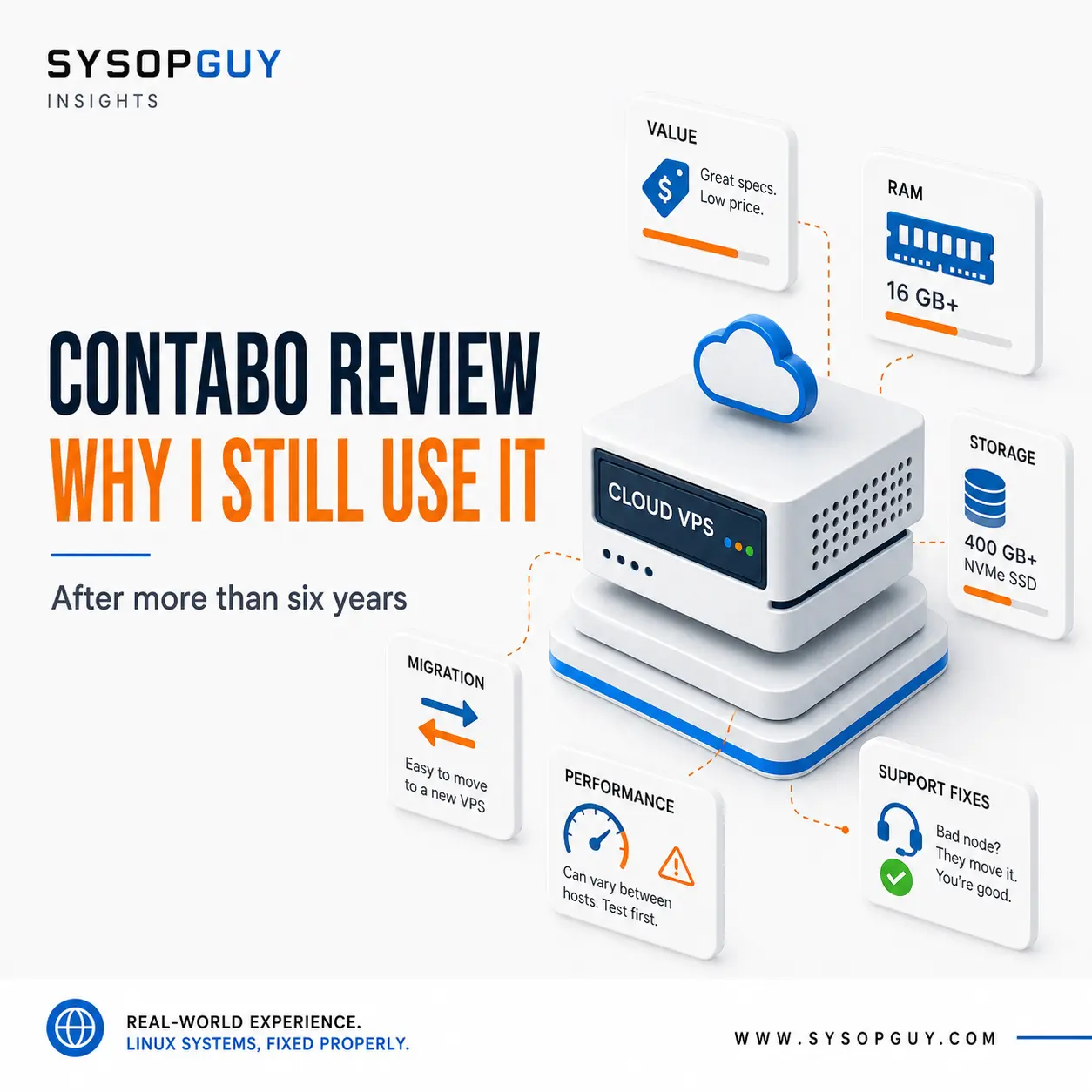
I have used Contabo for more than six years and currently run around ten VPS instances across several data centers. Some of them host production services.
That long-term use tells me more than a short benchmark ever could.
Contabo provides generous CPU, memory and storage at prices that remain difficult to match. For many Linux workloads, that combination works very well.
However, I never assume that every newly provisioned VPS will perform exactly the same.
Most of the instances I have received have worked as expected. A few clearly did not. That is why my opinion remains positive, but not uncritical.
Contabo offers excellent value when the workload fits and the new server is properly tested before production.
Why Contabo still fits many workloads
I use Contabo when a project needs practical resources more than a complex cloud ecosystem.
Many Linux servers do not require proprietary services, per-second billing or dozens of integrated products. They need enough RAM, useful storage, reasonable CPU capacity and a predictable monthly cost.
A VPS may host websites, MariaDB databases, mail services, monitoring, VPNs or other infrastructure components. For these workloads, the resources available to the operating system matter more to me than cloud features I may never use.
The price difference becomes especially relevant when several servers are involved.
A small monthly saving may appear insignificant on one VPS. Across ten instances, it becomes part of the real infrastructure cost.
Paying more can make sense when a workload needs specialised features, stronger performance consistency or a different service model. It makes less sense when the additional cost does not provide a practical benefit.
Contabo gives me a large amount of usable capacity for the money. That is the main reason it remains part of my infrastructure.
New VPS instances make migrations easier
I often prefer replacing an old VPS rather than upgrading the same installation indefinitely.
For example, when moving from Debian 12 to Debian 13, I normally create a new server and build the operating system cleanly.
This gives me an opportunity to review the old setup, remove obsolete packages and avoid carrying years of unnecessary configuration into the new installation.
I prepare the replacement server, configure the required services and restore websites, MariaDB databases, mail data and relevant settings from backup.
The final switch happens only after testing.
I check applications, permissions, scheduled jobs, certificates, DNS changes and mail flow before directing production traffic to the new system.
For a while, both VPS instances remain online.
Contabo’s pricing makes that overlap easier to accept. I do not need to rush the migration or destroy the old machine before I am certain that the replacement is complete.
The previous VPS also remains a useful reference. If I discover a missing file or forgotten configuration, I can recover it without rebuilding a machine that has already been removed.
Independent backups still remain essential. The temporary overlap simply makes the migration safer and less stressful.
Specifications do not tell the whole story
Contabo plans often include generous resource allocations, but the numbers on the product page cannot describe the full behaviour of a virtual server.
A virtual CPU does not perform identically on every physical host. Storage, networking and activity from neighbouring VPS instances also affect the result.
Most Contabo servers I have deployed have behaved normally for their intended workload.
Occasionally, however, a newly created VPS felt genuinely slow during ordinary use. The problem was not limited to an artificial benchmark. Disk operations, network performance or general responsiveness made the machine unsuitable for what I planned to run on it.
For that reason, I do not migrate an important service immediately after provisioning a new VPS.
I first check normal CPU behaviour, storage performance, network connectivity and general responsiveness.
I am not looking for impressive benchmark numbers. I only want to confirm that the server behaves as a healthy instance should and that it can support the intended workload.
A low price has little value when the underlying machine performs badly.
Support has acted on documented problems
When I find a real performance issue, I collect evidence before contacting support.
Saying that a VPS “feels slow” does not give the provider much to investigate. I prefer to document the symptoms and include relevant measurements or screenshots.
That approach has worked for me.
When I clearly demonstrated that a VPS was performing poorly, Contabo support moved it to another host. After the migration, the behaviour returned to normal.
I would obviously prefer every new instance to work perfectly from the beginning. Inconsistent host performance remains the main weakness I have encountered.
At the same time, infrastructure problems can happen with any provider. What matters is whether the issue receives a practical resolution.
In my cases, Contabo acted on the evidence and solved the problem. That response is one of the reasons I continue using the service.
Low pricing does not remove the need for administration
Contabo provides infrastructure. It does not remove the responsibility of managing the server properly.
A low-cost VPS still needs updates, hardening, monitoring and independent backups. Important services need a tested recovery plan.
The available RAM and disk space can also encourage people to install too much on one machine simply because everything still appears to fit.
Resources should support a deliberate design, not become an excuse to place unrelated services on the same VPS without considering their impact.
I treat Contabo instances like any other Linux server: I verify the machine, secure it, monitor it and plan how its data will be recovered.
The attractive price changes the economics. It does not change the operational requirements.
Who Contabo is likely to suit
Contabo makes sense for people who can manage their own Linux systems and want substantial VPS resources at a controlled monthly cost.
It is particularly attractive when memory and storage matter more than access to an extensive cloud platform.
However, I would not place an important workload on a new instance without first testing it.
The expected service should determine whether the VPS is suitable. A small website, a mail server and a database-heavy application do not place the same demands on storage, network and CPU performance.
Workloads that need highly consistent compute performance may justify another platform or a dedicated server.
Price should remain part of the decision, but it should not be the only factor.
Why I still use Contabo
After more than six years, I still run around ten Contabo VPS instances, including production systems.
The reason is straightforward: when an instance performs as expected, the combination of resources and monthly price is extremely difficult to beat for many of my workloads.
Contabo also fits the way I prefer to handle major Linux migrations. I can build a clean replacement server, keep the old system available during testing and switch only when the new environment is ready.
The service is not flawless.
Performance can vary between hosts, so I test every new VPS before trusting it. When I have found a genuine problem and documented it properly, support has moved the instance and resolved the issue.
That is the honest balance after more than six years: strong value, useful resources and good long-term results, combined with the need to verify each new server rather than trusting specifications alone.
Need help with a Contabo VPS?
I can review a new or existing Contabo server, identify performance or configuration problems and help plan a safe migration without moving production services before the replacement is properly tested.