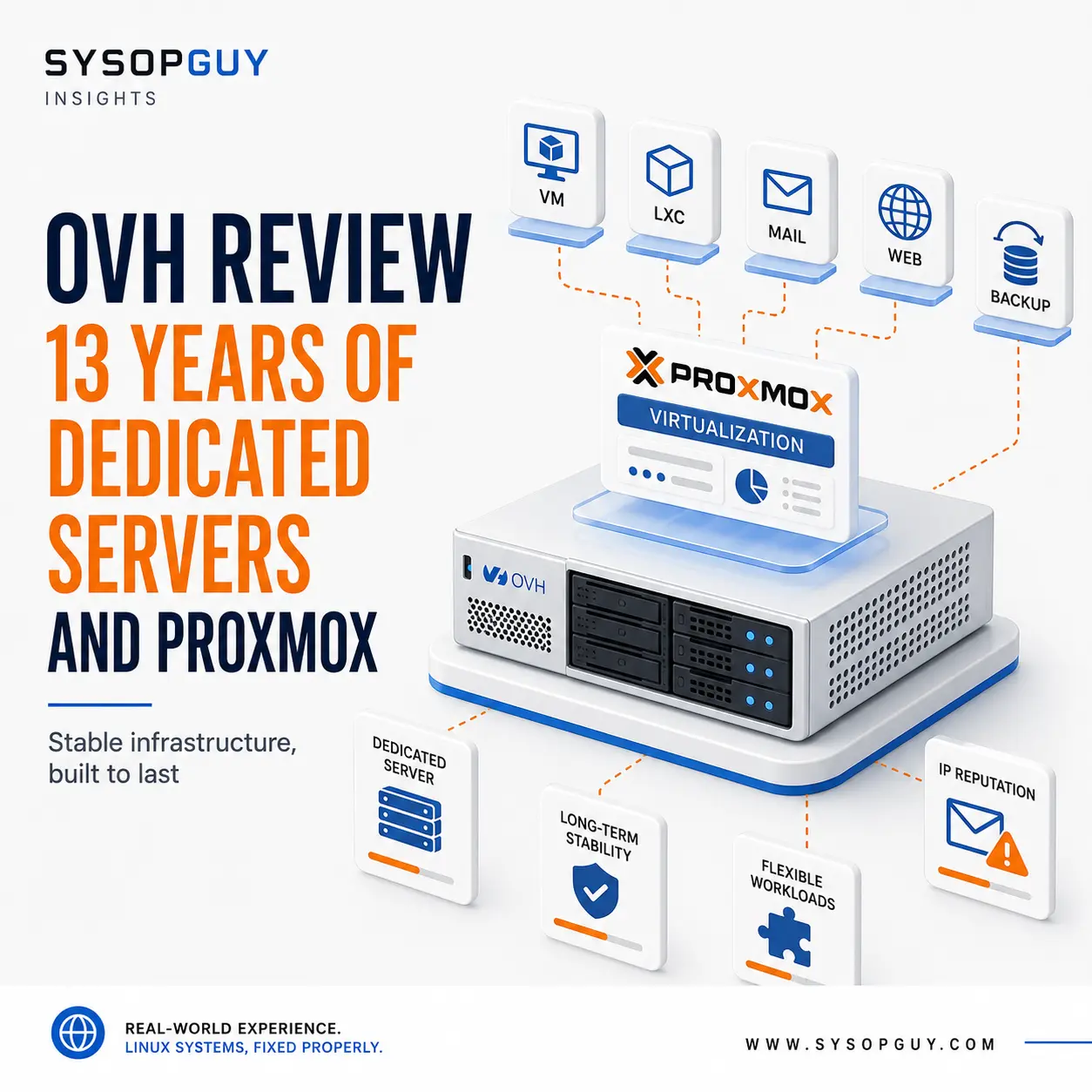
I have used OVH for around 13 years, mainly for dedicated servers.
My usual setup is simple: I rent the physical machine, install Proxmox, and build the actual infrastructure with virtual machines and LXC containers.
Over the years, I have also used servers from SoYouStart and Kimsufi. Each range has served a different purpose, from inexpensive laboratories to production systems that remained online for years.
OVH has consistently given me a strong balance of hardware, price, and stability.
It is not perfect. IP reputation, in particular, can cause problems. Even so, it remains one of the first providers I consider when I need dedicated infrastructure.
Why I use dedicated servers with Proxmox
I rarely rent a physical server to run a single application directly on the host.
Installing Proxmox turns the machine into a flexible platform. I can separate services, assign resources according to their actual needs, and choose the most appropriate environment for each workload.
I normally use a full virtual machine when I need a separate kernel, stronger isolation, or a complete operating system.
LXC containers are lighter and work well for many Linux services. Docker can then run inside the appropriate VM or container when an application requires it.
This approach also keeps the Proxmox host clean.
Web servers, databases, mail systems, monitoring tools, firewalls, and other components remain separated instead of sharing the same operating system.
That separation makes maintenance easier and limits the impact of individual failures. I can update or restart one service without unnecessarily affecting the rest of the infrastructure.
Snapshots are also useful before important changes, but only as a temporary rollback option.
They are not backups. A snapshot stored on the same physical server does not protect against storage failure, accidental deletion, or loss of the entire machine.
Independent backups and a tested recovery plan remain necessary.
OVH dedicated servers fit this model well because they give me direct control over the hardware while Proxmox provides the flexibility I need above it.
Choosing between OVH, SoYouStart, and Kimsufi
I have used all three ranges depending on the project and the offers available at the time.
Not every workload needs a recent processor, enterprise storage, or a large amount of memory.
A less expensive server can still run a useful Proxmox installation, several small virtual machines, LXC containers, or a complete testing environment.
Kimsufi has often made sense when keeping costs low mattered more than using recent hardware or having access to premium options.
SoYouStart covered the middle ground for many of my projects.
Standard OVH dedicated servers became the more natural choice when I needed a wider selection of hardware or when the machine had a more important production role.
I do not choose between them by comparing only processor models and monthly prices.
Storage layout, available memory, network capacity, expected load, backup requirements, and future growth all affect the decision.
A cheap server is not good value when it cannot handle the intended workload or forces another migration a few months later.
One of the strengths of the OVH ecosystem is the variety of machines available.
Older hardware can still work extremely well for many Linux workloads, especially when the infrastructure is designed sensibly and does not waste resources.
For me, choosing the right machine matters more than choosing the newest one.
Long-term stability
A dedicated server can have excellent specifications and still become a poor choice if the provider causes recurring outages or network problems.
My experience with OVH has been very stable.
The major incident I clearly remember was the exceptional data centre fire several years ago. Apart from that event, I cannot recall a repeated pattern of provider-side failures that made me consider moving my infrastructure elsewhere.
Most of the time, the servers simply kept running.
That matters more to me than small differences in synthetic benchmarks.
Production infrastructure needs stable connectivity, predictable hardware, and as few unexpected interruptions as possible.
Of course, OVH only provides the underlying infrastructure.
Proxmox, Linux, networking, virtual machines, containers, security updates, backups, and the services running inside them remain my responsibility.
During these 13 years, I have never needed to contact OVH technical support about a provider-side problem.
For that reason, I cannot give a meaningful opinion about the quality of its support. I have simply never had enough direct experience with it.
The main weakness: IP reputation
My main complaint about OVH concerns IP reputation.
I often find that newly assigned IP addresses already appear on one or more blacklists.
A previous customer may have used the address for spam, abuse, compromised services, or other activity that damaged its reputation before it was reassigned.
For a normal web server, this may have little practical effect.
Mail infrastructure is different.
A server can have valid reverse DNS, SPF, DKIM, and DMARC records and still experience delivery problems because the IP address has a poor history.
The new owner may inherit that reputation before sending a single legitimate message.
Because of this, I always check a new OVH address before using it for mail or another reputation-sensitive service.
I look at relevant blacklists, verify reverse DNS, and check for signs of previous abuse.
A correct server configuration cannot immediately erase the history attached to an IP address.
This is not exclusively an OVH problem. Large hosting providers reuse address space, and abusive customers can damage individual addresses or entire network ranges.
However, I have encountered the issue often enough with OVH to consider it the weakest part of the service.
It does not stop me from using the provider, but it does affect how I plan mail systems and other services that depend on external reputation.
Would I still recommend OVH?
Yes.
For dedicated servers running Proxmox, Linux virtual machines, and LXC containers, OVH remains one of the providers I trust most.
The combination of hardware control, reasonable pricing, and long-term stability has worked very well for me.
SoYouStart and Kimsufi have also remained useful when a project needed lower-cost hardware rather than the widest selection of features.
I would still evaluate every server according to the workload it needs to support.
Storage, network capacity, backup strategy, recovery requirements, and expected growth matter more than an attractive monthly price.
IP reputation also needs to be checked before deploying a mail server or another service where the history of the address matters.
Despite that limitation, my overall experience remains strongly positive.
After around 13 years, I continue to rent OVH dedicated servers, install Proxmox, and build infrastructure on top of them.
That continued use is the most honest review I can give.
Need help with Proxmox on OVH?
I can review an existing Proxmox environment, help design a new installation, or investigate problems involving virtual machines, containers, storage, and networking on an OVH dedicated server.