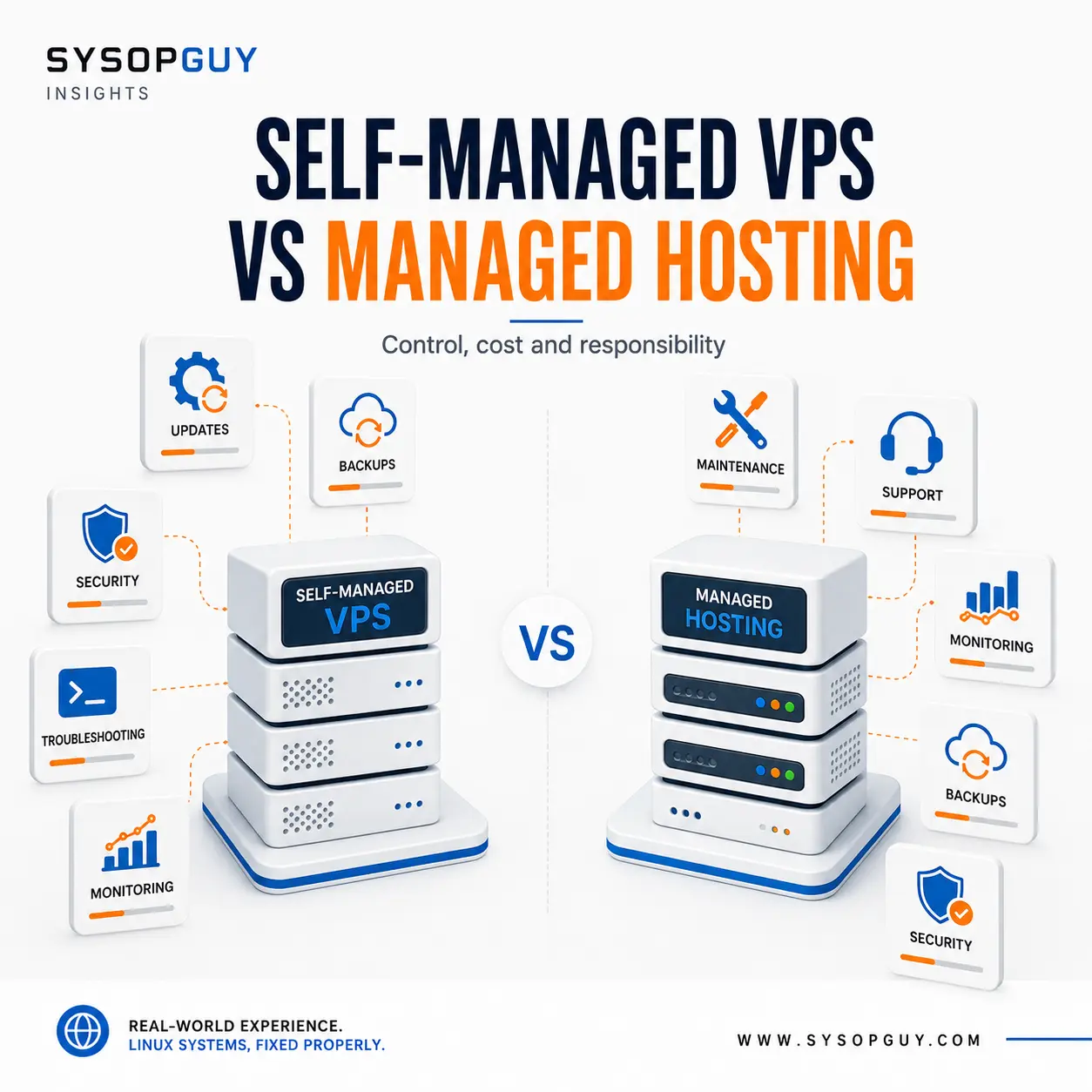
A self-managed VPS often looks like the obvious choice.
It is inexpensive, flexible, and gives you full control over the operating system. You can install the software you need, change the configuration, run containers, and avoid many restrictions found in traditional hosting plans.
The monthly fee, however, usually covers only the virtual machine.
It does not include someone maintaining Linux, monitoring your services, fixing configuration problems, or recovering the system after a failure.
Managed hosting costs more because the provider takes care of part of that work.
The real difference goes beyond price and performance. It comes down to how much control you need, how much administration you want to handle, and who should act when something stops working.
What a self-managed VPS actually provides
A self-managed VPS normally includes virtual hardware, network connectivity, an IP address, and access to an operating system.
The provider maintains the physical host, virtualization platform, and surrounding network. Unless the service agreement says otherwise, almost everything inside the VPS remains your responsibility.
That usually includes:
- installing operating system updates;
- securing SSH and other exposed services;
- configuring the firewall;
- maintaining the web server and databases;
- monitoring disk space and resource usage;
- renewing certificates;
- creating and checking backups;
- investigating failures.
Many providers offer a rescue environment or allow you to reinstall the operating system. Those tools do not repair the applications, configuration, and data already running on the server.
If Nginx stops serving a website, MariaDB refuses to start, or the disk becomes full, support may simply confirm that the VPS and network are working.
That does not necessarily mean the support is poor. It reflects the service model you purchased.
The monthly fee is not the full cost
A VPS can provide more RAM, storage, and processing power than a managed hosting plan while costing much less.
Administration accounts for much of that difference.
Updates take time. Backup jobs need checking. Failed upgrades, broken dependencies, expired certificates, mail delivery problems, and unexpected disk usage all require investigation.
Someone who enjoys managing Linux may see that work as part of the appeal.
A private user who only wants to run a website, personal cloud, game server, or online application may experience it as an unwanted second job.
A low-cost VPS remains inexpensive only while the time and effort needed to maintain it stay reasonable.
One serious failure can consume more time than several months of managed hosting would have cost.
Managed does not always mean fully managed
The word “managed” has no universal definition.
One provider may maintain only the operating system and control panel. Another may also cover the web server, databases, security updates, monitoring, and backups.
Custom software often changes the level of support.
A provider may exclude Docker containers, third-party scripts, unofficial packages, or manually modified services from its standard plan. Even a broadly managed service may not cover every application you choose to install.
Backup policies vary as well.
Some providers create automatic copies but never verify whether they can restore the complete application. Others keep only a short history or offer limited recovery options.
Before purchasing a managed plan, check what the provider maintains, which failures it will investigate, and which tasks still belong to you.
The actual support scope matters more than the label.
Control only helps when you need it
A self-managed VPS gives you freedom that managed hosting may restrict.
You can choose the Linux distribution, install custom packages, replace parts of the web stack, adjust network services, or build the environment around a specific application.
That control offers real value when the workload needs it.
Extensive customisation, however, makes the server harder for someone else to support.
No provider can guarantee every possible combination of unofficial repositories, modified services, custom packages, and application-specific settings.
As the system moves further from a standard installation, maintenance requires more knowledge and usually more investigation.
Customisation is not the problem. Trouble begins when someone chooses a self-managed server for its freedom but still expects another person to understand every undocumented change immediately.
Backups still need attention
Private users sometimes assume that the VPS provider automatically protects their data.
That should never be taken for granted.
Some providers include snapshots or sell optional backup services. These features can help, but they may keep every copy inside the same account or infrastructure. Deleting the VPS may also remove the available snapshots.
Snapshots are not always suitable for long-term recovery either.
Important data needs an independent copy, sensible retention, restricted access, and occasional restore tests.
Managed hosting may include backups, but the same questions still matter:
What does the provider copy? How long does it keep each backup? Where are the copies stored? How does recovery work?
The hosting model changes who performs part of the work. It does not remove the need for a recovery plan.
Security requires ongoing work
A fresh Linux installation does not remain secure forever.
Packages need updates. Applications develop vulnerabilities. Certificates expire, user accounts change, and configuration mistakes accumulate over time.
Public servers also attract automated scans soon after they appear online.
SSH, control panels, websites, mail services, and other exposed applications all need appropriate protection.
On a self-managed VPS, the user handles this maintenance.
Managed hosting can reduce the workload, but it cannot compensate for every poor application-level decision. Weak passwords, outdated software, vulnerable plugins, and exposed administration panels can still cause problems.
A managed provider may, however, handle more of the server-level work before an issue becomes a visible failure.
When a self-managed VPS makes sense
A self-managed VPS works well when you need control and accept the maintenance that comes with it.
It suits learning, testing, custom applications, VPNs, development environments, containers, game servers, and personal services that do not fit comfortably inside a standard hosting plan.
You do not need to be a professional system administrator.
You do need to accept troubleshooting as part of the service.
After a failure, the first step is to determine whether the cause lies in the provider’s infrastructure or inside your operating system and applications.
If the virtual machine and network remain available, you will usually need to solve the problem yourself.
When managed hosting makes more sense
Managed hosting suits users who care more about the application than the server beneath it.
A private user who simply wants to publish a website or keep an online service available may have little interest in maintaining Linux.
Paying more can make sense when the plan includes updates, monitoring, backups, security maintenance, and technical help when a service fails.
It can also prevent a server from running untouched for years simply because it still appears to work.
The best option is not always the one with the lowest monthly price. It is the one that matches the amount of technical responsibility you actually want.
Choosing the service model
A self-managed VPS and a managed hosting plan may run the same application, but they provide very different services.
The VPS gives you control and leaves you responsible for what you build.
Managed hosting transfers part of that work to the provider, usually in exchange for a higher price and some restrictions.
Before choosing, consider what should happen when the disk fills up, an update breaks the application, a certificate expires, or the server stops responding.
Who should investigate the problem?
The answer usually makes the right service model much clearer.
Need help with a self-managed VPS?
I can review an existing VPS, identify configuration or performance problems, and help recover services when the provider’s infrastructure is online but the system inside it is not working correctly.